
Hollow Hog artificial wildlife hollow creation in a living tree in Tasmania

Species-specific artificial tree hollow created using the Hollow Hog
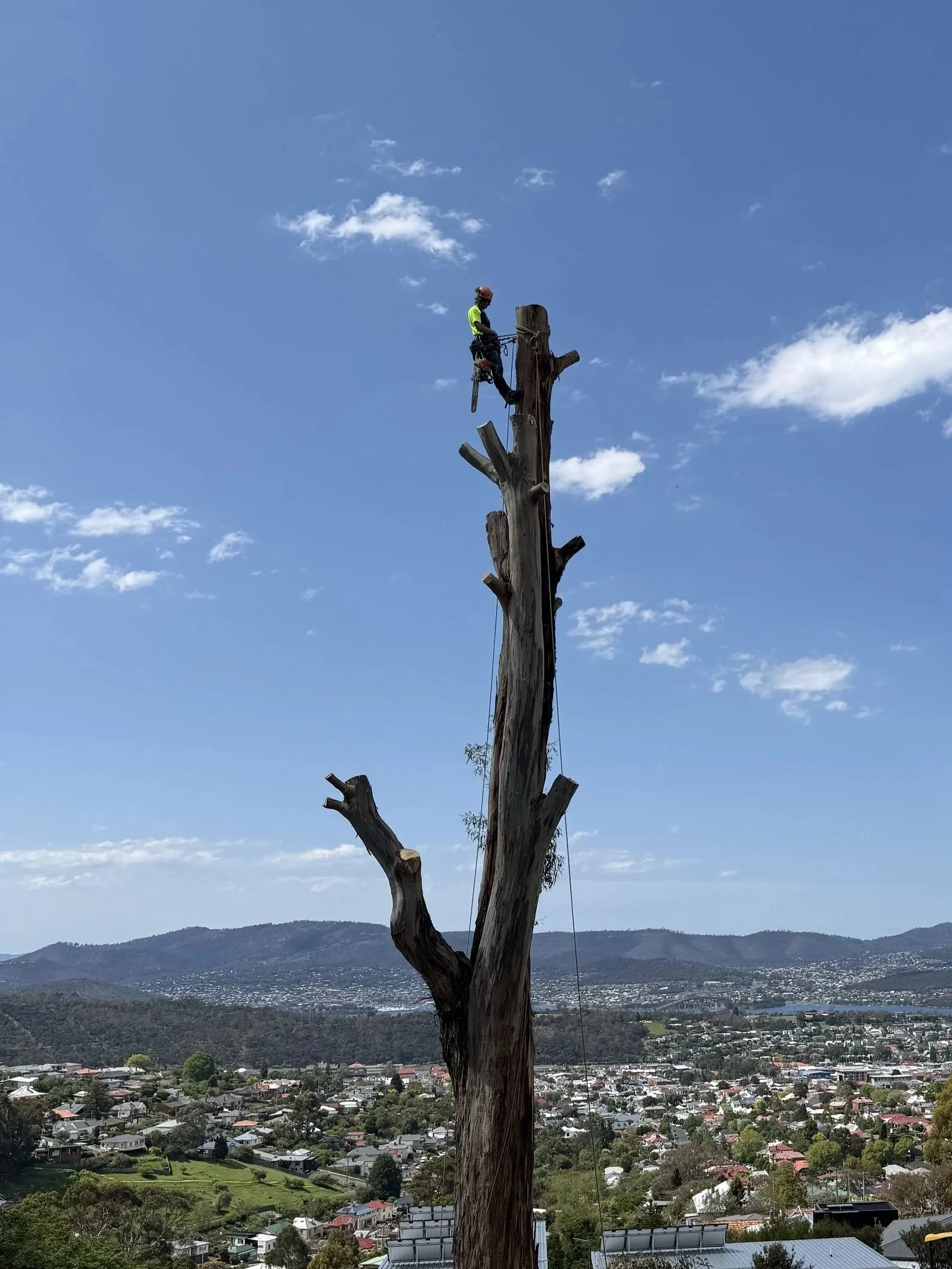
Artificial wildlife hollows created in a retained dead habitat tree.
Habitat Creation & Artificial Tree Hollows
Habitat Arboriculture provides specialist tree habitat creation across Hobart and Tasmania, including the creation of artificial wildlife hollows, habitat trees and retained habitat structures in both living and dead trees.
Tree hollows provide important nesting, roosting and shelter opportunities for a wide range of native wildlife. Where suitable natural hollows are limited, carefully designed artificial hollows can be incorporated into retained trees to increase the habitat value of a site.
Our habitat creation work can be tailored to the tree, site and target species, with consideration given to hollow size, entrance dimensions, orientation, location within the tree and the surrounding habitat.
A key tool we use for this work is the Hollow Hog, a purpose-built habitat-carving tool designed specifically for creating internal cavities in trees.
Planning a habitat creation project?
Contact Habitat Arboriculture to discuss artificial hollows, habitat trees and specialist ecological arboriculture throughout Hobart and Tasmania.
Hollow Hog Habitat Creation
The Hollow Hog is our preferred specialist tool for creating artificial tree hollows.
Rather than cutting a large opening into the side of a tree, the Hollow Hog allows an arborist to work through a relatively small entrance and create a substantially larger internal cavity within the trunk or branch.
This gives us considerable control over the shape and dimensions of the hollow while keeping the external opening relatively small.
The Hollow Hog can be used in both living and dead trees, making it useful across a wide range of habitat creation projects — from retaining a dead tree as a habitat structure through to introducing carefully designed cavities into suitable living trees.
Why We Use the Hollow Hog
There are a variety of specialist tools and methods available for artificial hollow creation.
These include traditional chainsaw-carved hollows and newer purpose-built carving systems such as the Hollow Hog and Arbor Grub.
We primarily use the Hollow Hog because its design allows us to create substantial internal cavities through a comparatively small entry point and gives the arborist considerable control over cavity size and shape.
The choice of tool is only one part of the process. The quality of the final habitat feature depends on selecting an appropriate tree, positioning the hollow carefully and designing it around the ecological objectives of the project.
Recent Australian research has also evaluated HollowHog-carved hollows as part of long-term wildlife habitat programs, providing a growing evidence base for their use as an artificial hollow-creation technique.
Species-Specific Wildlife Hollows
Not every hollow should be the same.
Different hollow-dependent animals have different requirements, so habitat creation can be tailored toward particular species or groups of wildlife where appropriate.
Depending on the project, we can consider factors such as:
Entrance-hole size and shape
Internal cavity dimensions
Depth of the hollow
Height above ground
Orientation and aspect
Drainage
Accessibility to the target species
Protection from weather
Surrounding vegetation and habitat connectivity
Existing hollows and other habitat features within the tree
Where a project has defined ecological objectives, hollow design can be informed by the target fauna and the characteristics of the site.
For larger projects we are also happy to work alongside ecologists, land managers and other environmental professionals.
Artificial Hollows in Living Trees
Suitable living trees can provide opportunities for long-term habitat creation.
Creating a hollow in a living tree requires careful consideration of the tree's species, size, health, structure and location.
The objective is not simply to carve the largest possible cavity. The hollow needs to be appropriately sized and positioned for the host tree, while also providing a useful habitat feature.
Because living trees respond to wounding over time, their future growth and management also need to form part of the design.
Not every tree is suitable for artificial hollow creation, and tree selection is an important part of the process.
Habitat Creation in Dead Trees
Dead trees can be extremely valuable habitat structures.
Where a dead or declining tree can be safely retained, complete removal is not always the only option.
The tree may instead be reduced to an appropriate height and retained as a habitat tree or habitat monolith, with artificial hollows and other habitat features incorporated into the remaining structure.
This can retain ecological value that would otherwise be lost if the entire tree were removed.
Artificial hollows can also be created within suitable dead stems, branches and retained timber.
Where appropriate, a single habitat tree may provide opportunities for multiple features designed for different types of wildlife.
Turning Tree Removals Into Habitat
Habitat creation can also form part of a tree removal or risk-management project.
Where the upper canopy of a dead, declining or structurally compromised tree needs to be removed, it may be possible to retain part of the trunk as a habitat structure rather than removing the tree completely.
Features can then be deliberately incorporated into the retained tree, including:
Artificial wildlife hollows
Habitat cavities
Coronet and natural fracture-style pruning
Retained branch stubs
Deadwood habitat
Crevices and smaller microhabitat features
This approach can be particularly valuable in parks, reserves, larger properties and environmentally sensitive sites where retaining habitat is an important project objective.
Habitat Creation for Councils, Land Managers and Environmental Projects
Habitat Arboriculture can undertake habitat creation as part of larger arboriculture, conservation and land-management projects.
This may include work for:
Councils and public land managers
Bushland and reserve managers
Environmental consultants
Ecologists
Developers undertaking habitat mitigation
Schools and community organisations
Private landowners
Conservation and revegetation projects
Projects can range from a single habitat hollow through to multiple-tree programs involving artificial hollows, habitat-tree retention and other specialist arboricultural work.
Habitat Creation Across Hobart and Tasmania
Habitat Arboriculture is based in Hobart and provides specialist habitat creation services throughout Tasmania.
Our climbing and technical arboriculture experience allows habitat features to be created in parts of trees that may be difficult to access from machinery or the ground.
We can undertake individual residential habitat projects as well as larger commercial, government and environmental works.
Discuss a Habitat Creation Project
If you are considering artificial tree hollows, Hollow Hog habitat creation or the retention of trees for wildlife habitat, get in touch with Habitat Arboriculture.
If your project has a target species, ecological report, tree assessment or habitat-management plan, send that information through with your enquiry so the work can be planned around the intended ecological outcome.
Contact Habitat Arboriculture to discuss Hollow Hog habitat creation and artificial wildlife hollows in Hobart or elsewhere in Tasmania.